REFRACTIVE ERRORS OF THE EYE
REFRACTIVE ERRORS
Refractive
error/refraction error, is a problem with
focusing light accurately on the retina. The most common types of refractive error are near-nearsightedness, farsightedness, astigmatism, and presbyopia.
Nearsightedness:
When the optics are too powerful for the length of the eyeball one
has myopia or nearsightedness. This can arise from
a cornea or crystalline lens with too much
curvature (refractive myopia) or an eyeball that is too long (axial
myopia). Myopia can be corrected with a concave lens, which causes
the divergence of light rays before they reach the cornea.
Farsightedness:
When the optics are too weak for the length of the eyeball, one
has hyperopia or farsightedness. This can arise from a
cornea or crystalline lens with not enough curvature (refractive
hyperopia) or an eyeball that is too short (axial hyperopia). This
can be corrected with convex lenses, which cause light rays to
converge prior to hitting the cornea.
Presbyopia:
When the flexibility of the lens declines, typically due to age. The
individual would experience difficulty in near vision, often relieved
by reading glasses, bifocal, or progressive lenses.
Cylindrical
errors cause astigmatism, when the optical power of the eye is too
powerful or too weak across one meridian, such as if the corneal
curvature tends towards a cylindrical shape. The angle between that
meridian and the horizontal is known as the axis of the cylinder.
Astigmatism:
A person with astigmatic refractive error sees lines of a particular
orientation less clearly than lines at right angles to them. This
defect can be corrected by refracting light more in one meridian than
the other. Cylindrical lenses serve this purpose.
Other
terminology include anisometropia, when the two eyes have
unequal refractive power, and aniseikonia which
is when the magnification power between the eyes
differ.
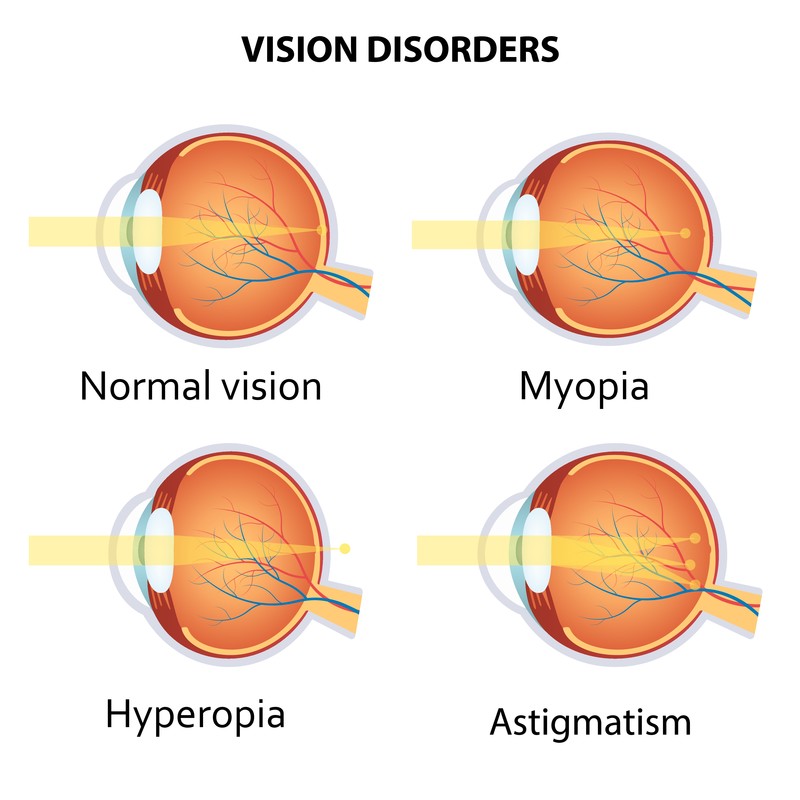 |
| Fig.1. Refractive Errors |
EPIDEMIOLOGY and PROBLEM STATEMENT:
The
number of people globally with refractive errors has been estimated
at one to two billion. Rates vary between regions
of the world with about 25% of Europeans and 80% of Asians
affected. Nearsightedness is the most common
disorder. Rates among adults are between 15-49%
while rates among children are between 1.2-42%. Presbyopia affects most people over
the age of 35. The number of people with
refractive errors that have not been corrected Is huge and it
is one of the most common causes of vision loss along
with cataracts, macular degeneration, and vitamin A
deficiency.
SYMPTOMS:
Nearsightedness
results in far away objects being blurry, Farsightedness and Presbyopia result in close objects being blurry, and Astigmatism
causes objects to appear stretched out or blurry. Other
symptoms may include double vision, headaches, and eye strain.
 |
Fig.2. Common Complaints of a Person having Refractive error |
DIAGNOSIS:
A complete eye examination can easily diagnose refractive error. Blurry
vision may result from any number of conditions not necessarily
related to refractive errors. Vision defects caused by refractive error can be distinguished from other problems using a pinhole occluder, which will improve vision only in the case of refractive error.
A doctor uses a trial frame and trial lenses to measure the person's refractive error. The diagnosis of a refractive error is
usually confirmed by an eye care professional during an eye
examination using a large number of lenses of different optical
powers, and often a retinoscope or an automated refractor to objectively estimate a person's refractive error.Following that "objective refraction" the clinician
typically shows the person lenses of progressively higher or weaker
powers in a process known as subjective refraction. Cycloplegic
agents are frequently used to more accurately determine the amount of
refractive error, particularly in children.


Fig.3. Subjective Refraction Fig.4. Objective Refraction
COMPLICATIONS:
- Recurrent eyelid infections (styes/ blepharitis/chalazion).
- Development of Squint (cross eyes)
- Amblyopia (Lazy Eye)
- Predisposition to other eye diseases (eg. Glaucoma, Retinal holes and Retinal Detachment, Keratoconus etc.).
MANAGEMENT:
How
refractive errors are treated or managed depends upon the amount and
severity of the condition and any associated complications if present. Those who possess mild amounts of
refractive error may elect to leave the condition uncorrected,
particularly if the person is asymptomatic. For those who are
symptomatic, glasses, contact lenses, refractive surgery, or a
combination of the three are typically used. Complications are actively looked for and managed accordingly.

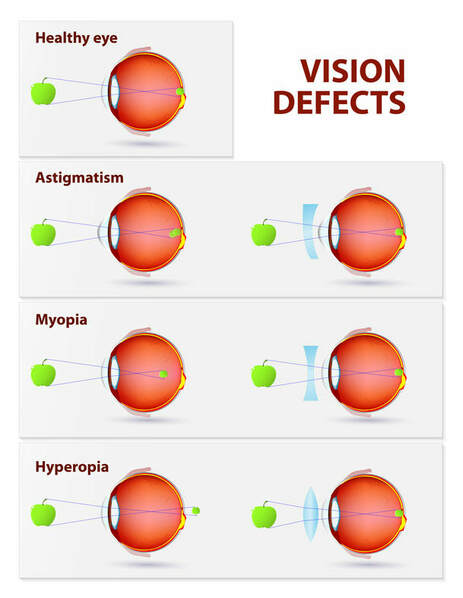
Fig.5. Principles of management of Refractive errors
Please comment and give your suggestions for topics of your interest.
Thank You.
* The author is a Consultant Ophthalmologist,Eye Surgeon and Medical Director of Prem Jyoti Eye Care and Hospital, Bhilad(India)
Nicely summarized.
ReplyDeleteThank you very much
Delete