CATARACT SURGERY & INTRAOCULAR LENSES
CATARACT
SURGERY & INTRAOCULAR LENSES

Cataract
surgery is all about removing the hazy/opaque lens in your eye, and
in most of cases, replacing it with an artificial lens. In fact, it
is among one of the most frequently and successfully carried out eye
surgeries across the globe.
The Right Time to have Cataract Surgery:
When
dealing with cataract removal, your doctor may ask you the following
questions and accordingly decide to proceed with cataract surgery:
- Is it difficult for you to carry out your daily or occupational activities?
- Is your ability to drive or to work at night being affected?
- Is reading or watching television becoming cumbersome for you?
- Do you have issues in cooking, shopping, taking medications or climbing stairs?
- Do you feel difficulty in seeing under bright lights?
- Is your level of independence getting disturbed?
- Is your problem manageable through alternative ways?
CATARACT
SURGERY:
Cataract
surgery is a microscopic surgery usually performed under local or
topical anesthesia. The cloudy lens is removed by one of the surgical
techniques and is replaced with a clear implant called an
Intraocular Lens (IOL) to
restore vision. In most cases, no stitches are needed and the eye
heals quickly after surgery.
TYPES
OF CATARACT SURGERY:
1. Phacoemulsification:
Also
known as ‘Phaco’, it is the most common technique used for
cataract removal nowadays. Usually, it takes no more than half an
hour to remove cataract through phacoemulsification, and that too,
requiring only local or topical anesthesia. This procedure requires a
small surgical incision around the edge of the cornea, inserting a
small ultrasonic probe into the opening to break up the cloudy lens
into tiny fragments using sound waves and suction of broken down
cataract fragments. Once the lens particles are removed, an IOL is
implanted in the natural lens capsule.
2. Manual Small Incision cataract surgery:
Also
called as MSICS or Manual Phaco. This is the cataract procedure used
in case where phacoemulsification may not possible for various
reasons. A slightly larger incision is required for this cataract
removing technique, so that the cataract can be removed in one piece
instead of being fragmented within the eye. Just like
phacoemulsification, an artificial lens (IOL) is placed inside the
capsular bag. No sutures are required to close the wound and it is a
highly safe and reliable technique.

3. Intracapsular cataract surgery
Though
rarely used nowadays, this cataract removal technique may still be
useful under certain circumstances. It comparatively requires a
larger incision through which the entire lens with surrounding
capsule is removed. Moreover, the IOL (intraocular lens) has to
placed in a different location, as there is no capsular support.
4.
Laser-assisted cataract surgery:
Also
called LACS is a modern variation of the standard phaco cataract
procedure. In laser cataract surgery, a number of steps that
traditionally have been performed with a hand-held surgical
instrument are instead done with a computer-controlled, high-speed
laser for added precision. These steps include: making the initial
incisions in the eye; creating an opening in the anterior capsule of
the lens to gain access to the cataract; and fragmenting the cloudy
lens prior to its removal from the eye.
TYPES
OF INTRAOCULAR
LENSES (IOL):
There
are different types available, and your surgeon will help you
understand which qualities you need and which lens material best
suits your needs.Your
surgeon will help you choose the ideal lens for you. The Eye
surgeon is an expert on all available lenses and how their individual
benefits pertain to each patient’s needs.
Types
of IOL Materials -Materials
continue to improve, becoming more pliable and bio-stable and
evolving to address specific vision needs. The earliest IOLs were
made with a thermal plastic, a material that improved dramatically
over the years, but still had inherent restrictions for microsurgery.
Today’s state-of-the-art acrylics offer better plasticity and
stability and give surgeons superior control during microsurgery.
Polymethylmethacrylate (PMMA):
Once
the standard for excellence, these lenses are not as pliable and
conducive to micro procedures as newer materials. They are rigid and
thus require a larger incision for insertion and are commonly used in
MSICS surgery.
Silicone:
Also a
popular choice that is giving way to advanced acrylics better suited
to micro incisions. Certain bio-material advantages make silicone
lenses the ideal choice for some patients.
Hydrophobic Acrylic:
Today’s
most popular choice in part because it’s easy to fold and ideally
suited for microsurgery. Most lens implants are performed with these
advanced acrylics and have excellent success rate.
Hydrophilic Acrylic:
Similar
to the Hydrophobic acrylic but with comparatively poorer bio-adhesion
properties. However they are more economical.

FUNCTIONAL
TYPES OF IOL:
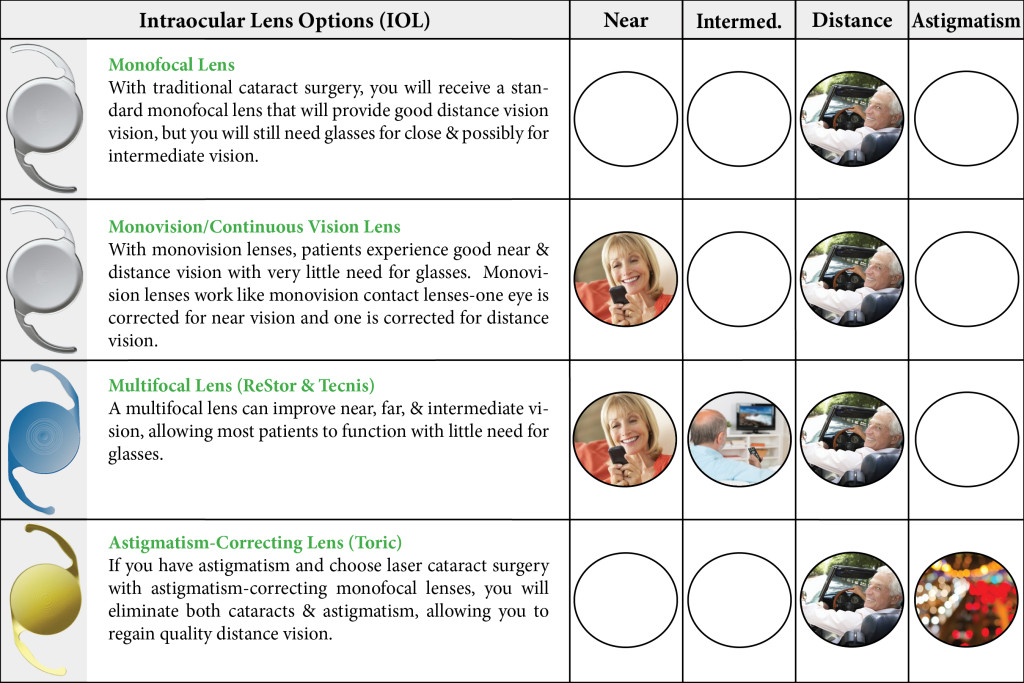
Monofocal
IOLs:
These
lenses have been around longest and are still the most common IOLs.
Though the quality of materials and designs continue to improve, the
function of the lens remains constant. A mono-focal IOL has equal
power in all regions and a single zone of clear focus, producing
excellent vision from a determined distance. This gives excellent
distance vision, but requires wear glasses for near-vision needs like
reading. A smaller number of patients choose lenses that focus at a
nearby point. This gives them excellent near vision, but they need to
wear glasses to see distant objects.
Some
patients choose distance vision for one lens and near vision for the
other (called mono-vision) and rely on the brain’s natural tendency
to compensate, often producing excellent vision near and far. Your
surgeon will discuss this option and explain the key role your
dominant eye plays in the decision.
Multifocal
IOLs:
These
special lenses continue to evolve with designs that offer a variety
of regions with different power and several zones of clear vision
within a single lens, allowing patients to see a continuous range of
vision from long, intermediate and near distances. Results vary
depending on each person’s eyes and IOL choice, but the vast
majority of patients with multifocal lens implants achieve excellent
levels of clarity and a general improvement over a broad range of
vision. Rings and halos can occur, and your surgeon will discuss
these concerns with you to make sure you understand all aspects of
your options.
Accommodating IOLs:
These
revolutionary IOLs flex like a human lens to achieve the continuous
range of vision a person would have naturally. The lens accommodates
itself to the shape of the eye, literally changing its shape and
allowing itself to focus on both far and near objects. After
implantation, patients typically function well without glasses for
distance and intermediate viewing and often do not even require
glasses for casual reading. Glasses are typically needed for fine
print and micro tasks.
Toric IOLs:
The
only lens type that can correct astigmatism, toric IOLs have
different powers in different areas of the lens that align with the
patient’s vision correction requirements. This alignment demands
the lens be positioned in a precise configuration, placing greater
emphasis on your surgeon’s expertise and surgical skill. They
typically reduce the power of glasses at all distances and can
minimize the need to wear glasses for distance vision.

Is
cataract surgery serious?
All
surgery involves some risk, so yes, it is serious. However, Cataract
surgery is the most commonly performed type of surgery. Many cataract
surgeons have several thousand procedures under their belt and
chances of complications to occur are relatively rare. However some
preexisting conditions in the eye or the body may predispose to
certain specific complications.
What
is a "secondary cataract"?
In a
minority of cases (perhaps 20 to 30 percent), months or years after
cataract surgery, the posterior portion of the lens capsule that is
left inside the eye during surgery for safety reasons becomes hazy,
causing vision to again become blurred.
This
"secondary cataract" (also called posterior capsular
opacification or PCO) usually can be easily treated with a less
invasive procedure called a YAG laser capsulotomy. In most cases,
this 15-minute procedure effectively restores clear vision.
THE
NEED OF GLASSES AFTER A CATARACT SURGERY:
This
would depend on the type of intraocular lenses (IOLs) used for you.
The advanced intraocular lenses such as multifocal or accommodating
IOLs greatly reduce dependency on glasses and in most cases even
reading glasses can be avoided. Rarely does anyone have to wear thick
eyeglasses after
cataract surgery these days. In fact, premium Multifocal
and
accomodating IOLs
can
even eliminate your need for reading glasses after cataract surgery.
How
much does cataract surgery cost?
It
varies from one doctor to
the next and it also depends on the type of procedure and intraocular
lens you and your doctor
decide is best for your
needs.
What
are the possible side effects of cataract surgery?
As
with any surgery, pain, infection, swelling and bleeding are
possible, but very few people experience serious complications. In
most cases, complications or side effects from the procedure can be
successfully managed with medication or a follow-up procedure. To
reduce your risk for problems after cataract surgery, be sure to
follow the instructions your surgeon gives you and report any unusual
symptoms immediately.
Please feel free to ask for any query pertaining to this blog or any other eye related topics.
Please comment and give your suggestions for topics of your interest.
Thank You.
* The author is a Consultant Ophthalmologist,Eye Surgeon and Medical Director of Prem Jyoti Eye Care and Hospital, Bhilad(India)
Very nicely presented. And great information about Various types of eye lenses used in cataract surgery.
ReplyDeleteNice information in simple words!!!
ReplyDeleteLike it
ReplyDelete